
From the Bug River area to the Subcarpathian region, Eastern Poland is a terrain of contradictory memories about multicultural tolerance and past violence. These memories induce a number of ethnic and social stereotypes that tend to be highly contested and politicized by various political and religious groups in both Poland and Ukraine. Julia Buyskykh carried out research on religious culture in several confessionally mixed local communities on Poland’s eastern border in 2015-2016. She found that the collective memory of their inhabitants was not only deeply rooted in the history of the 20th century, but indeed in the whole historical context of the period before the partition of Poland. Her research revealed that religion greatly influenced the respective perceptions of history: often the collective memory of Greek Catholic, Orthodox Christian and Roman Catholic neighbors in the same local community was different. Polish-Ukrainian relations in the past, as well as reciprocal “postcolonial” traumas also left their mark on the strategies of communication between researcher and interlocutors. Thus, some questions that arose in the course of her main research were: How do people of a certain community live neighbourly in a multicultural world that proclaims tolerance outwardly, and how do they reduce the negative effects of the conflict of memories in everyday life? How do they elaborate a strategy of tolerant co-existence under the burden of contested memories? The lecture will focus on these issues, drawing on rich ethnographic data from Ms. Buyskykh’s fieldwork in the Polish-Ukrainian borderland.

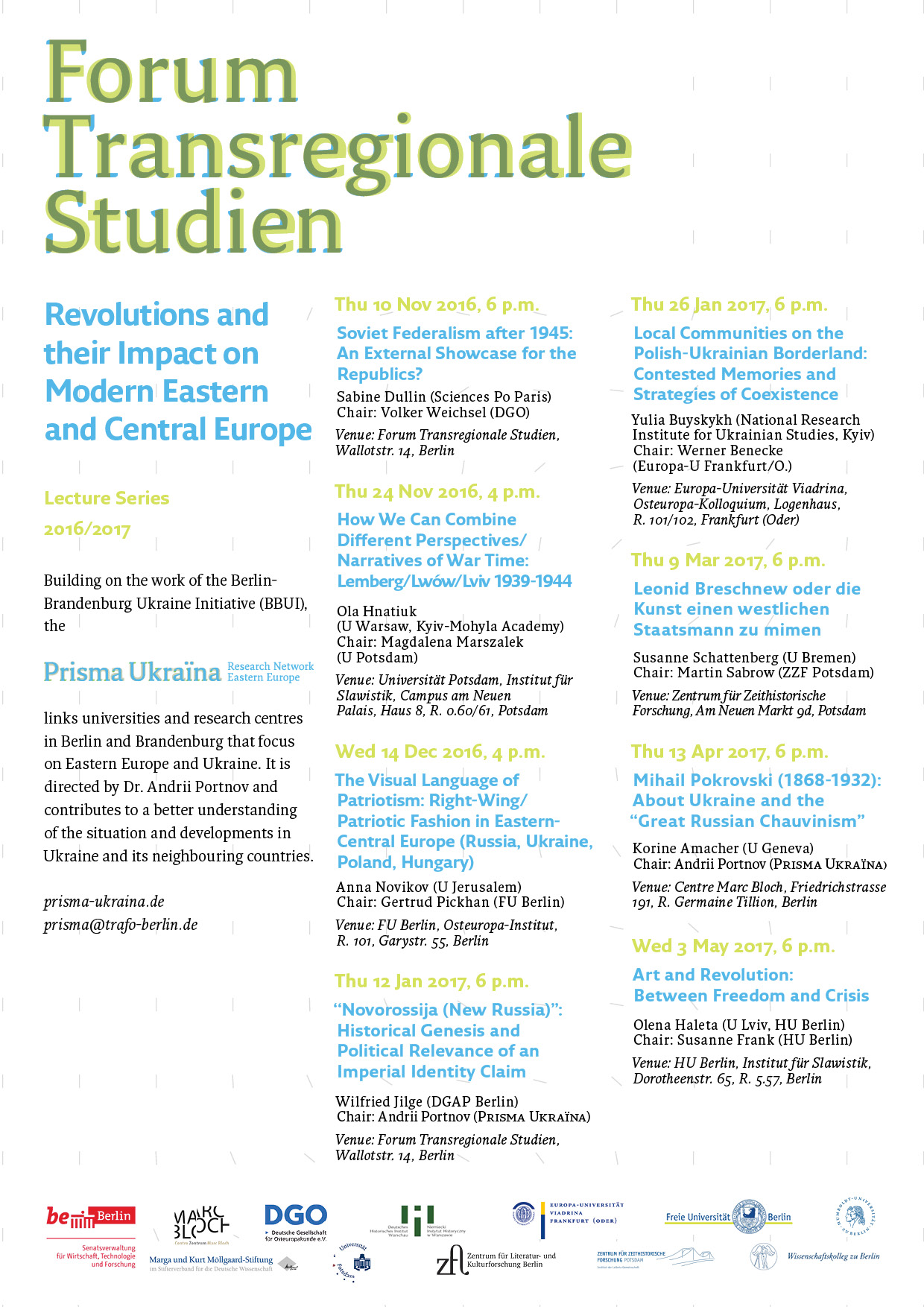
Local Communities on the Polish-Ukrainian Borderland: Contested Memories and Strategies of Coexistence
Yuliia Buyskykh graduated from the Taras Shevchenko National University of Kyiv with a BA in History (2006) and an MA in Ethnology (2007). In 2010 she obtained her PhD (Kandydat Nauk) and from 2010 to 2014 she worked at M.T. Rylsky Institute of Art Studies, Folklore, and Ethnology at the National Academy of Sciences of Ukraine. Dr. Buyskykh’s research in Poland started in September 2014. She participated in the Polish Government Program for Young Scientists (Program Stypendialny Rządu RP dla Młodych Naukowców) in 2014/2015 and completed an internship at the Department of Ethnology and Cultural Anthropology, University of Warsaw (IEiAK UW). From 2015/2016 she was a fellow of the V4EaP Scholarship Program, financed by the International Visegrad Fund. She worked as a participant of two research projects focusing on religious issues in Ukraine and Poland, which were financed by the Polish National Centre of Science (Narodowe Centrum Nauki). Since September 2016 Dr. Buyskykh has been working at the National Institute of Ukrainian Studies under the Ministry of Education and Science of Ukraine. Her research interests include anthropology of religion, neighborhood relationships, border studies, Ukrainian studies and folklore.